Pages

Search This Blog

Friday, February 18, 2022

Feb 2022: Mid Update (Centurion's Profit Alert and Initiation of Nanyang Holdings)

Profit Alert for Centurion

Perhaps the one above had heard my desperation and decided to bestow some good news upon me. 

Centurion had announced that there is a hefty profit alert.

"...the Group is expected to record a substantial increase in the net profit attributable to equity holders of the Company for FY2021 by not less than 200% as compared to a net profit attributable to equity holders of the Company of approximately S$17.2 million for the corresponding period in 2020"

At 33.5 cents a share, the current market capitalization stands at 281.6m. A 200% gain would put net profit at the 50m region, which will make the stock look cheap (at last?).

The announcement narrates the reasons for this improvement:

"(i) the expansion of the Group’s portfolio of purpose-built workers accommodation (“PBWA”) in Singapore and Malaysia since the fourth quarter of 2020; and 

(ii) the steady recovery of occupancy of the Group’s purpose-built student accommodation (“PBSA”) assets in the United Kingdom reaching 82% for the second half of FY2021; 

as well as due to a fair valuation loss of approximately S$3.1 million in FY2021 as compared to a fair valuation loss of approximately S$27.6 million in FY2020 in relation to the Group’s investment properties.

"

The expansion of PBWA is expected, and hopefully should be the main reason for improvement. The increased in PBSA is welcomed, but not expected to be the main contributor since it was not contributing significantly to the top line earlier. The fair valuation loss of 3.1m, improved from an earlier fair value loss of 27.6m in the previous year, means that:

If the profit was 17.2m last year, should we add 27.6m of valuation loss (since it is largely paper loss) back to the bottom line of 2020, it would mean that the net profit was 44.8m.

At an estimated 50m this year, the improvement is not much. Henceforth, I would pay attention to the numbers arising from the PBWA slice of the business. The recovery of the PBSA was always in the cards, it was just a matter of when.

Would Centurion choose to restart its dividend distribution this time?


At 0.02 per share in 2019, that would mean a yield of almost 5.9%, which is extremely desirable. However, with the mindset of a business owner, I would prefer that they pare down its debt with its free cash flow.

Update on 27-Feb-2022:
Results were much better, and the debt level was pare down by a modest 20 million. However, the dividend proposed was a paltry 0.005$ a share, much lesser than the expected 2 cents a share. The company put up a resolution to restore director and management pay for voting as well. This news depressed share prices, and whatever paper profits from profit alert, prior to announcement, were all but vanquished.

Obviously, I am very disappointed, as this company was my best foreseeable hope in 2022. As it stands, my returns are -6%, and henceforth significantly trail the STI and HK indices. This would likely be the worst performance in 5 years.

Initial Capital Injection into Nanyang Holdings (HKEX: 212)

The history of Nanyang Holdings had an uncanny similarity to Berkshire Hathaway. In 2009, it made the painful decision to cease its textile operation, paying up to 40m to end construction of a factory. There were about 20 employees in 2009. Today, there are only 13.

Instead, they decide to turn their focus into property rental, converting the space of the space which the company held land use right of (in the form of joint ventures with their Chinese counterparts in mainland China), to office or factory rental. Their prized property is Nanyang Plaza in Hong Kong. 

Throughout the decade, they invested and increase, through rights issues, in their shareholding in Shanghai Commercial and Savings Bank (SCSB). The major shareholder is also the chairman of this entity, and this shareholding is very likely extremely long term.

Lastly, the company has an investment portfolio that is growing, though insignificant when viewed against its total assets.

Layman Valuation

The sum it up:

As of 19-Feb-2022:

Market Capitalization: 1.35B HKD
Source: https://www.hkex.com.hk/Market-Data/Securities-Prices/Equities/Equities-Quote?sym=212&sc_lang=en 

1) Investment Portfolio: Fair value of 456m HKD. 
"Equities comprised approximately 80.2%
(of which U.S. 41%; European 14%; Japanese 5%; Asia ex-Japan 27% and Emerging Markets 13%),

bonds 11.8% (of which U.S. 85%; European 3%; Emerging Markets 5%

and others 7%), commodities 2.2% and cash 5.8%."

2) Investment in SCSB: 2.2B HKD

3) Nanyang Plaza: 2.47B (based on level 3 valuation, hence least reliable)

4) Total Liabilities: 104.7m

After some pretty liberal discounting:

The Net Asset Value of 3.3B implies at significant 240% margin of safety after very conservative discounting. In case you ask, I discounted the valuation of Nanyang Plaza heavily, because the cap rate is on the low side of 3.x% currently.

Share Buy-backs and Cancellation
It appears that the management recognizes that the company is undervalued, and hence has been buying back and cancelling shares at a heart-warming rate. It is rare to see shares being cancelled away instead of just sitting still in the treasury, or worse, becoming stock options for management.

In case you noticed, there is a huge amount of Share Buybacks (figures in the centre column is in millions of HKD) in 2015, representing 200.745m of shares, at the price of about 33 HKD. This is through a tender offer by management to existing share holders.

The other bulk share buybacks occurred in 2019, 2008, 2007 and 2020. 

The current price of almost 40 HKD implies a significant amount of premium, but when we consider that there were share buy backs in 2019 and 2020, 40 HKD doesn't seems so bad.The amount of float, as in the number of shares in millions, has reduced from 43.9m to 34.16m in 2021. That is a 28.5% reduction over a span of 15 years. That is a 1.7% compounded, yearly.

Dividends

The dividend record is fair. Green lines represent the % yield, and the blue bars represent amount in HKD.

Risks

The share buy backs signifies shareholder alignment, which is great. But what are the downsides?

-inability to continue joint ventures with the Chinese partners due to conflict, regulation (unable to renew land use rights, regulation, etc)

-Significant losses from the investment portfolio due to active management. The company makes decision on its portfolio based on macro and economic trends, far too sophisticated for a value simpleton like myself. There will bound be times where they will trip badly. However, the value of the investment portfolio is not a huge concern as the following, which is...

-Political issues between Taiwan and Mainland China, as SCSB is mainly running its business in Taiwan. SCSB does have stake in SCB (Shanghai Commerical Banks) which has branches in Hong Kong and China.

-Liquidity is on the low side. Hence, do not over allocate too much of your portfolio into such stocks. In the event that you need cash, this would be a burden.

As the value is apparent, I have started injecting capital into this company. 4.25% of my portfolio is vested, and there are currently 12 companies vested, with the top 5 holdings representing 73.08%. I plan to accumulate heavily into this stock.

Thursday, February 10, 2022

Feb 2022 Portfolio Updates

S&P 500 Index Fund: -7.61% (Jan)-> -4.13%
Hong Kong Tracker Fund: +3.63% -> 6.02%
Straits Times Index Fund: +2.92% -> 9.18% (amazing +6 in a matter of weeks)

My portfolio: -2.64% -> -1.96%

Notable Transactions:

1. Significant Reduction (>50%) of Central China Real Estate (CCRE) (HKEX:832)

The motivation to reduce positions comes from knowledge that promissory / IOU notes between subsidiaries are not paid timely or not being paid. When asked, IR replied that they do not wish to respond to unverified news. I guess I have to make a judgement call and reduce position. 

Losses incurred is about the region of 20%.

I have not added nor reduced positions in Central China Management (HKEX: 9982) as of now, and there is no plans to do so.

***

Comments

Cutting loss in CCRE is the latest of a series of loss making trades which unfortunately I have to endure since divesting Perfect Shape/Medical.

Significant losses were also incurred earlier on ,selling out Futu Holdings and there is also a huge amount of unrealized losses in Didi Global (50%)

I am extremely humbled and ashamed, and my confidence has taken a backseat these days. It does feels like I have been taking on too many 50-50 bets, whereby the outcome and probability is about the same. 

I would like to apologize if you had taken and followed some of my ideas.

It was heart wrenching to take these losses because the capital is not just my own.

All that is left is a time for self reflection; and unfortunately these mistakes does not provide enlightening lessons-- only reminders. At best, I could only chalk it up to inexperience and a lack of emotional control-- I was committing capital into half-bucket, difficult ideas far too easily. Perhaps I could not contain my contrarian urges to bet. I should have emphasize heavily on risk, and control my capital discipline.

At worst, perhaps I am not suitable to play this game, and that I was just plain lucky for the last two years.

Coupled with the fact that my mum would have to go through more tests, as well as my knees deteriorating significantly these days, my mood is now as gray as the skies. Frankly, I am craving some kind of good news desperately.

***

The top 5 positions of my portfolio is still largely the same. I would try my best to briefly state the risk in these positions

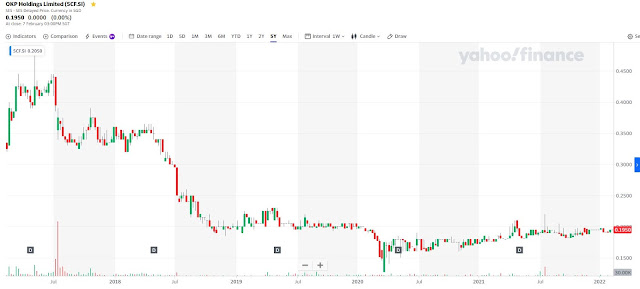
1. OKP (34%)

OKP went nowhere for 5 years.


In terms of valuation, OKP bears the lowest risk of the portfolio. Arbitration between the PIE viaduct designers and OKP will commence in Sep and OKP stated that its outcome will be material. Only God knows whether it will be contribute or negate.

2. Alibaba Group (11.6%)
Besides unforeseeable political risk, there is a good to fair chance of bearable losses due to overvaluation. Current price is not a bargain. I just have far too little ideas, and usually giant cap companies do revert in value pretty quickly. Moderate growth with (low) probability of surprise special situations (IPO/spin off of Ant Group/Cloud) could bring about satisfactory profits.

3. Carpenter Tan (10.9%)

The 1 year chart for Carpenter Tan. It wasn't kind.


I am paying attention to its inventory and I am not very positive of this counter. Market feels likewise, and hence the stock is down moderately since the last time I looked at it. I do not expect much, and at best there will only be a humble little dividend. Which is great, since the climate nowadays demands some level of prudence.

4. Central China Management (10.2%)

Spin offs are usually rewarding, but CCMGT had been punishing. The balance sheet is definitely not as ugly as this chart.


Business is slowing and stemming the decline would be great news. With the declining earnings, I think the price is definitely not overvalued, but market pricing is, as always, not predictable.

5. Centurion (9.7%)

Centurion trades at as high as 70 cents in the past 10 years, 50 in the last 5.


I do not expect any surprises, but I do believe this stock would probably perform better than others in my portfolio.

***

Selling out due to market cycles

Criticism usually involves a very public, successful figure getting stick from low-lifes who may never amount to a fraction of what the former had achieved

Unfortunately this section is going to be representative of such.

Hence, the low-life (me) is going to keep this short, since I am not doing terribly well these days.

There is a lot of talk in town about this extremely prominent Youtube figure call MeetKevin, who had sold out of his 20-million (?) portfolio. His 35 minute video, which I will embed below, explains his rationale.


a) He believes that we are at the top end of the market cycle and he interprets earnings reports as well as Fed actions to signal that it is turning down. His decision is enforced by his experience in real estate.

b) Feels that the market is in for a huge decline, possibly lengthy.

c) Emphasize that he eventually have to hop back onto "Train America" if he sees signs of reversal.

--------------------------------------------------------

So for people following MeetKevin in his footsteps, they are attempting to answer the following questions:

(1) When is the storm going to happen (they think it is soon)
(2) How long would it last (even harder to predict) since (c)

I believe most of us observed that the market is getting unstable. Volatility in the popular growth stocks aside, it appears that inflation numbers are gapping up. So I could at least agree that the market seems to be edging towards a cliff.

I am not a sophisticated investor, so I focus on what I can do (bottom up investing), but how many macro investors could really trade in and out of crisis? 

More often than not, the market can be very humbling, and for most of the time, the market (my opinion) is a leading indicator of public opinion. It could be right or wrong, but one thing is for certain, by the time it is obvious, it is usually too late. How many of us thought the end of the world in March 2020, only to see the market gains ATHs shortly?

I can accept that the market could be in pain for the next 4-5 years, but my job is to pick companies and that is how I try to generate my alpha. I try to look for businesses that are cheap, and if they were cheap today, I am not going to forsake them just because an economic storm seems to be brewing. The idea of selling out is more rationale for someone who is trading on indices. 

If a company is trading cheaply today, and it is down 30% in the near future, in the absence of debt and issues that can cause a company to be insolvent, one should bet more. Buying stocks is all about believing in market eventually regaining sanity; not betting on when it will lose or regain sanity(pricing assets too highly or low). 

If there is a need to raise cash, the right course of action is to reduce positions in unfavorable bets in the portfolio, such as (1) companies that are over-leveraged and has unstable cashflows (2) richly valued or even fairly valued (3) thesis has diminishing chance of playing out. I have stocks in my portfolio that could meet these criteria. But to liquidate the entire portfolio.... is suggesting to me that this guy has no interest in business valuation, the total essence of what the stock market is about.

Note: If the smartest value investor (Buffett), that has been fighting this war for decades, is holding significant amount of cash (Berkshire), then yes, the market is definitely not in bargain basement levels. But to sell out everything is a different matter altogether.

I bet Buffett have a list of companies in which he would snap up if there is a 40-60% discount off today's prices.

There was a book call 100 Baggers: The take-away I had is that none of the companies did it in a matter of 4-5 years and certainly most companies need decades, which is exactly the same duration which MeetKevin fears the market pains could last.

We should focus on the easy stuff.

Tuesday, January 25, 2022

Jan 2022 Portfolio Update

S&P 500 Index Fund: -7.61%
Hong Kong Tracker Fund: +3.63%
Straits Times Index Fund: +2.92%

My portfolio: -2.64%

Notable Transactions:

1. Complete divestment of Mapletree North Asia Commercial Trust
With the merger with Mapletree Commercial Trust, the pricing of MNACT would be correlated to it. Since MCT is largely priced in, there is unlikely any possible value. MCT's yield, post-merger, would be bigger, but the gearing would similarly increase. Overall, MNACT has not been a satisfactory investment. It was unable to fill up vacancies in its China properties and a long-drawn COVID has not been kind to Festival Walk. Annualized returns are in the region of 15%, dividends included.

2.Complete divestment of Genting Singapore
Divested this for my mum in order to purchase more Alibaba.

3. Increase of Alibaba
Increased holdings for mum and dad's portfolio.

4. Slight increase of Central China Real Estate Ltd
Increased holdings for mum and dad's portfolio.

***

Comments
Investment returns is expectedly poor as the last two years were too good to be true. For someone doing value investing, the concept of reversion to mean is palatable. Hence, this performance is kind of expected. 

STI and Hong Kong (sans the tech firms) underperformed last year, and it was not surprising that they are outperformers so far.

There is nothing to suggest that the downtrend for China property, developer and services firms would cease anytime soon. Particularly for CCRE, the worry was again debt, since there is a likelihood that companies, and not just CCRE alone, is procuring debt from other means. Could we trust what is stated in the financial statements? We can only hope.

In the last few weeks, sell down in tech stocks has been overwhelming. The NASDAQ is down 11% as of writing; and several tech stocks got sold down very badly the night before. 

SE limited was down by 10% or more but recovered just 3% lower than last close.
Futu Limited has a similar story.
Tesla, the darling of 2021, had fairly similar chart patterns.

I do not have strong opinions and affinity to tech stocks, particularly those who had done by well since 2020-21. IMO, they are largely priced in, or should I say the stock is priced to perfection. 

Going forward to 2022, looking at my portfolio, the returns will be impact by recovery on both COVID, Chinese debt crisis, as well as the outcome from OKP's impending arbitration proceedings, which the management cited as material.

Monday, January 17, 2022

Methods of Determining Value

The following outline the general methods in which I look for value in the market


1) Adjusted Book Value

As the term suggests, this is more than looking at the "shareholder's equity" value of the balance sheet, and taking into what the account that some assets are more reliable than others.

In a bullish market, an investment portfolio that consist of stocks in vogue (such as Perfect Medical's investment in tech stocks) should be adjusted downwards. Obviously you have to make a judgement call. Likewise, it might be prudent to be skeptical with property valuation which are based on level 3 inputs, or those based on a very low capitalization rate. More so, such valuation are less trustworthy if they were valued by the same company over an entire decade.

(cap rate = rental / property valuation; hence if rental does not change over the years, this would suggest that valuation has gone up, which can be unreliable). 

Good will will classically be adjusted downwards to zero by most geriatric investors (like myself). 

A note about non-interest bearing liabilities, such as payables. Always remember that account payables should be adequately covered by account receivables. Inventories should be revised aggressively downwards unless appreciation over time is possible (luxury watches, for e.g.). 

Look for an increasing net current assets throughout the years-- it is usually a sign of an attractive company.

This is, by far, my favourite.


2) Heavy Insider Buying

Between salaried employees and majority shareholders, I would certainly prefer that salaried employees be the ones buying stock, and that of reasonably large sums. I recalled before the ship sunk for Noble (the commodities trading company in Singapore), the owner was buying huge chunks of shares. Owners can be irrational.

Unfortunately, this could be the same case as one of my major holdings (Central China Real Estate Holdings), so I do feel uncomfortable writing this.

Company share buybacks are less convincing than directors buying stock out of their own pockets. Shares, from the former, could be willfully used for employee share option schemes, instead of cancellation.


3) Low PE adjusted for cyclicality

Within the category of  price to earnings, one could argue that Company A is trading lower than its peers in an industry group. This falls under what I call "relatively undervalued," which is one of my least favorite kind of valuation. For instance, company A could be selling at 20 times earnings and deem cheap, if most of its peers are selling at 40. Obviously 40 is high number, and 20 is not modest.

If you were to find companies that fit John Neff's criteria, in the area of neglected growth, that is even better. Neff have this beautiful simple formula which takes growth in earnings (as a percentage) + dividend and divide the sum by its PE. Comparing this with the index, it does reveal bargains. But I am not a fan of this approach and I do not use it as it is too complicated for me.

Generally I am not a fan of using earnings.


4) Troubled stocks selling at a low free cash flow multiple

This is one of my favourite categories-- of course not all companies could generate consistent cash flows. I use an average of multiple years of cash flow, against the market cap, as a gauge of bargain. Unfortunately, there is always some kind of trouble involving these companies, and holding them takes a lot of heart and patience.


(The following are what some call 'special situations')

5) Restructuring

A company consisting of different business segments may choose to rid itself of the underperforming ones. For instance, a company dealing with a loss-making student hostel accommodation, and a very profitable foreign worker lodging arm, could choose to sell off the student hostel business. This would result in better earnings in the end, and is likely to cause the share price to appreciate.

This is one way how a loss-making company could outperform a profitable one.


6) IPO/ Spin-offs

This does not refer to the typical IPO which happens very often when the market is frothy. I am referring to perhaps, company A, who has a huge chunk of stock in B, which is going public through the form of an IPO. 

Generally, an IPO underwriter try to serve two parties of interest-- the owner, which wants the price as high as possible; and itself, who wants to set a price modest enough so that price appreciation is possible. The latter is much less probable these days. 

Spin offs refer to companies who wish the list a subsidiary, by distributing shares to existing share holders of the parent. The main motivation of such an act is to reward management in the spin-off, or to improve the financial conditions of either the parent or the spin off. Sometimes a spin off could be used to highlight how undervalued the parent is, usually when view from a "sums of the part" perspective. 


7) Going Private Situations

When a company decides to de-list, it would usually have a reasonable amount of success by offering a respectable premium over its last transacted price, or book value.

By offering this premium, most existing shareholders will cash out so as to avoid the pain of watching the price fall back to pre-announcement levels. On the other hand, arbitrageurs, or parties acting in concert with management, would hold on and vote favorably to de-list.

On the flip side, when deals fall apart, and the price do fall back to pre-announcement levels, it might be wise to accumulate some shares. I have two reasons why this might be ideal: 1st, the pre-announcement price is likely reasonably modest, or else why would there be interest for a de-listing? 2nd, the interested party is likely to try again sometime in the future.

---

There are other niche areas, such as distress investing, bond buying, price arbitraging; but these means are far too complicated for myself and hence not practiced.

Tuesday, January 11, 2022

Thoughts and Lessons from Best World

During my short 6 year journey in investing, Best World was the brightest and tout-after stock. It is particularly rare that a stock listed in Singapore could return an investor multiple folds of his capital. It was well capitalized than most, at least in its reported financial statements, and it defies repeated sell downs of considerable magnitudes.

However, being the odd-ball value investor that I am, I seem to ignore popular issues, no matter how exciting the numbers are. I see it as a boon and a curse; the former because it protect me from huge drops when growth halts... a curse because well... I do miss out on those gains.

So when Best World was suspended, I do not feel the pain (or relief for not being) of existing stock holders. Time passes very quickly. It is already more than 2 years since that fateful day. Signs of life stirred when an announcement was made that they plan to privatize the company, and they would require financing to do it. That gives me an impression that the offering price would be reasonably high.

Unfortunately, it doesn't feel certainly that way now. Best World offered to buy up to 10% of the existing float at... 1.36 SGD, which was the last traded price, from any shareholders that are willing to give it up.

It is understandable that many are displeased. Some deem the decision as opportunistic and that it is a sign of things to come.

Personally, I felt that it is too early to conclude that the board is not acting with the OPMI's interest at heart. But I cannot claim to understand how shareholders feel, with funds stuck in the dark for 2 years, starving for light, but only to see the dancing flame on the candle blown out by a straying breeze.

This is a timely reminder that capitalism is cruel. Why are companies listed in the stock market? Cheap capital. Great businesses are far and few in between, and great businesses owners that think for OPMI is even more so. A good business owners obtain capital with the least cost (interest from debt; or dividend/equity from stocks). Pre-IPO investors eye for huge slices to be ultimately realized when the company turns public. With the odds stack against him (or her), only an astute retail investor, located at the bottom of the food chain, could plausibly consistently make money off the stock market.

When stock prices go too far south, it makes sense for the owners to load up using their own cash. Sometimes when an impending wave of fortune approaches, they could de-list at a respectable premium (though it is far less than it is actually worth, long term). One cannot expect retail investors to have an edge over the owners in winning this fog of war. 

The market has far too many matured businesses or management with care-taker attitudes, whose only reason for going public is to cash out. After-which, the risk of the business is for us retail investors to bear,

We need to be reminded of this: When going public, owners do not lose control of their business or their incentives, but only of control of its market valuation. 

After listing, stone-hearted owners has a myriad of ways to privately enjoy the spoils. Obscene salaries is one; huge bonuses (often justified by undemanding performance targets) is another; Generous stock options, approved by a pliant remuneration committee is common; others, leaning towards criminal, such as writing off trade receivables due to their own privately owned businesses, and much much more.

It is a cruel world out there.

Saturday, December 25, 2021

Value Investing: In my own words

The following is an extract of an interview which I prepared for. Hence, the divider might not seem to make sense. Bear with me.

The following is an extract of an interview which I prepared for. Hence, the divider might not seem to make sense. Bear with me.


What is “value investing” in your own words? 
Loosely speaking, there are two general fields of value investing. The contemporary side is to look at growing business at a reasonable price. These can be business of any size, as long as they demonstrate real growth. Mathematically, real growth is not just an increase in revenue but also an increase in cashflows. A true synergy should result not just in bottom line improvements, but also profit margins.


So this is what Graham call investing by projection. The pro of this approach is that time is usually a friend. As the business compounds its value over time, even if you have been a little off with your valuation. This is the more well known version of value investing today.  
 
But I think this approach is harder because you have to think about moat, disruption, etc. You also have to assume certain numbers about the growth and discount rates. If you ask a fellow investor of the same company, what the price is worth, it can differ a great deal. You can easily overpay for quality. Just look at Alibaba at the moment. 
 
So you usually hold on to these companies as the value compounds. If you pick the right company, sometimes you don’t ever sell them. That is the best thing about GARP-- you buy one decent company and time compound its value wonderfully. Not 100-baggers were a result of a year or two of brilliance.  


The other side of the fence is investing by protection. So you look at the business from liquidation value. You look at its assets, you look at its liabilities. Usually the business quality is average because the market is not that stupid. So there might be problems with the company, but there should not be an issue with it as a going concern*. Investing in cheap companies is where I am comfortable in. 


GARP is usually a qualitative bet while investing in cheap companies (“by protection”)is usually a quantitative exercise. It is far easier to tell that a company is cheap than if it is good. 


With buying cheap companies, you are more likely to sell when the value-price mismatch has narrowed. I prefer to invest by protection. When the price goes down meaningfully, 15% or more, I feel extremely comfortable to invest even more money… The odds are better when the price is going down. I am not an institutional investor so I can wait for a long time for value to revert. I don’t have anyone to answer to. So I could buy the more reprehensible company imaginable. But there is a lot more churn (buying and selling) than GARP.


I think value investing has been unfairly bashed and, the process, over simplified. 

Value investing is more nuanced than just looking at price to books and PE ratios


I pay attention to news about companies or sectors with problems because I have a healthy respect for EMH (efficient market hypothesis)—again I think discounts only comes with uncertainty and problems. But the management should not be the source of the problem.  

When a company becomes that cheap, as Walter Schloss says, many good things can happen. He called it 3 strings to a bow: first… the company could buy back shares; secondly, if the company is that cheap, it can be bought over; and lastly, the problems could be resolved over time and value can revert. 
 
So the perfect opportunity is when a GARP becomes cheap statistically and it is under a problem through no fault of its own (stock market crash, sector issue). I tend to look at company valuation by enterprise value (market cap + debt minus cash) divided by average earnings, not EBIT or worse EBITDA. I am very conservative. 


The typical value investor portfolio usually consist of a mix of these along with special situations as a form of protection. Special situations include arbitrages, spin-offs, and restructuring. These special situation stocks depend far more on corporate action and less on market sentiments… they can be a drag during bull markets but are wonderful buoys during bears. On a long-term basis, participating in only special situation stocks would be satisfactory. 

I have a healthy respect for the efficient market hypothesis. Most stocks are fairly priced, or should I say overpriced given how conservative I am, most of the time. The only time where price falls far from value is when there is uncertainty.  
 
The scope of this uncertainty/problem could range from globally or regionally, or an entire sector, or just the company alone. I find that in the same order, the frequency of this kind of opportunity goes from high to low, and the potential returns are from fair to high. 


Scope of Uncertainty 

Frequency/Incidence 

Potential Returns 

Global/Regional 

Low 

Fair 

Sector 

Medium 

Medium 

Company 

High 

High 


Always look at what the insiders are doing. 


I think the key to doing fine in investing is to understand the limits of your ability. The stock market is like stepping into an exam hall that provides you thousands of exam questions, and those with the highest marks are not necessary the ones with the hardest question.  
 
I am a simpleton, so I spend time looking for easy problems. I find my patience tested constantly, both by waiting for the simple problem, and also by the value reversion. Quite often I find myself losing discipline. So I understood what Buffett meant in the introduction of the revised edition of "The Intelligent Investor"


"To invest successfully over a lifetime does not require a stratospheric IQ, unusual business insights, or inside information. What's needed is a sound intellectual framework for making decisions and the ability to keep emotions from corroding that framework This book precisely and clearly prescribes the proper framework. You must supply the emotional discipline."


What most value investors would neglect to tell you, is the emotional worry between buying and that very moment where the seed sprouts (if it happens). The state of the mind frequently swings between stubbornness and self doubt.


That, is value investing in my own words.

Sunday, December 12, 2021

2021 Year End Review (numbers review, projections, bagholders and indexing)

//I am posting this up ahead of time due to family reasons.

//as of 17-Dec, 11pm Singapore Time, I have sold out of Futu Holdings.

2021 has been an incredible year due to 1 and only 1 stock: Perfect Shape Medical. Returns has been monetarily rewarding but intellectually lacking. I am not proud of the idea as much as perhaps Xinghua Port. Realized P&L from Perfect Shape represented 80% of total returns. 

Here are the numbers, screen captured from Stock.cafe. The portfolio currently has a time weighted returns of more than 10% over SPY, and hopefully should remain this way at the end of the year.


Overall XIRR is 29.89% but largely skewed because of the last two years of returns. The market has been very kind to me.

Interestingly, my portfolio has been far more volatile than SPY, but less so that the Hong Kong Tracker Fund. Volatility is not an important measure for value investors.

Max Drawdown is also higher compared to SPY this year, but it was nothing compared to what Hong Kong investors suffered. On the bright side, I think if you could endure draw downs like this, you could endure almost anything.

Dividends returns % in total returns

Dividend returns is only 8% of my total returns this year.

This is significantly lower (~30%) than last year's returns because of the complete divestment of Perfect Shape /Medical. Perfect Shape Medical is currently yielding 0.427 cents of its 5.94 HKD price. The median price of my holdings back then was about 2.5 HKD, which means it is 15-17% yield had I held on. But could I stomach the loss of 50% opportunity to sell had I held on? 

The answer is a strong no. The management seems to cheerlead its stock far too much, and the other reason for selling the stock is potential di-worse-ification-- it could be spreading its resources far too thin across too many fields. I don't regret selling Perfect Shape one bit.

That doesn't mean that the management is wrong-- perhaps they could pull it off and this article would not age well.

My investment strategy is mainly towards capital gains. Dividend is just salary for the waiting.

Looking Forward to 2022

This is the section which is going to get me into trouble.

In terms of expected returns, I would repeat what I said in 2020's year end review: I pretty much doubt I could do better than what I had in 2021. 2020 was a great year, 2021 was incredible. I would be very happy to beat the index by a meaningful margin, and that is all I wish for.

Some bold hopes and projection for 2022:

OKP

I hope that OKP would value revert soon. The company is back to winning contracts and hopefully earnings will return to pre-accident levels. There are a few ways this can happen, besides increase profitability:

a) Increased share buy back

b) Going private: I would be happy with a 40% premium, although that is actually a good deal for whoever is buying over OKP at this price. Given the Or's majority stake, they are the only possibility of this happening.

c) Acquisition of a more "interesting" business (unlikely)

d) Special dividend (also unlikely)

At this moment, I am looking at my portfolio and thinking about my position sizing. It is unlikely I would increase shareholding in OKP. In the event that a market crash of 30% and upwards, I would likely to purchase local bank stocks and index funds as I am generally out of ideas at the moment. 

China Property Sector

I am not optimistic of the Chinese property market as a whole. There will be casualties. This is a classic case of leverage gone wrong. Yes, one could make a case that the Chinese government is responsible for issuing the 3 red lines policy, hence introducing turbulence in this sector. I would argue that leverage has been adopted too freely, and the G was right to bring this to heel. 

My bets on the Chinese property sector is marked by sizeable and meaningful investments (17% of total portfolio) in Central China Real Estate and Central China Management. The latter is very cheap on cashflow: but if the market does suffer a meltdown, the biggest casualty would not just be the highly-leveraged, but the banks. I would expect the G to inject capital, and perhaps nationalize the debt in some manner. 

Perhaps they could force the companies into some kind of convertible debt issue (i.e. the ones some auto had made with the US Govt in 2008-9), or replace the managements. But as of now, I still believe that in the worst case scenario, CCRE is one of the better ones around, and CCMGT is probably more than priced in, in the event of a meltdown. Both have been backed by adequate insider buying, which is comforting to me. These two companies represent the best chance I got when recovery takes place.

Alibaba

I am going to offend a lot of people in this section.

Returns are likely to be lackluster at best. I do not expect permanent loss of capital. As it stands, I am about 14% down. The market is very generous to growth; and punishing when it doesn't. I think Alibaba as of now is fairly priced, but moderate growth should bring about market-equaling returns. There is a strong possibility of the Ant Group IPO, but that is in the mercy of the markets. Surely during a bear year, no one would be in the right mind to IPO? Would they be so kind of distribute Ant Group in the form of a special situation, such as a spin-off? Unlikely. 

So I am going to put my head out there and value it using my layman understanding:

The e-commerce business, in the latest interim, contributes about 12B USD. The cloud computing and entertainment branch, as well as its "innovation" branch are still loss-making. 

They could possibly spin off the cloud computing branch. The cloud computing segment contributes about 5.6B in revenue for the last six months (or 12B USD annualized). It appears to grow 30%, so let say if we give it a 5x-10x Price to Sales ratio value, that is 60B-120B.

33% of Ant Group belongs to Alibaba. If it had gone through its 35B USD IPO then, Alibaba stake would be worth ~11B USD (~452B HKD). Its latest interim earnings was 1.7B USD

To guess-timate very, very conservatively,

Alibaba current market cap is 339B USD

-E-commerce, if it contribute 24B in annualized earnings, on a P/E of 10-15= 240B-360B

(There were whispers that at current valuation, one is only paying for the e-commerce business and everything else is free. That is only the case if e-commerce is valued highly. I am not sure, going forward, if there is sufficient margin of safety)

-Cloud Computing= 60B to 120B, average it and give it a 90B.

-Ant Group IPO= at 1.7B USD interim, is worth about 3B USD x 15 PE= about 45B. If Ali owns 1/3 of it, that is about 15B.

Sum it up, Alibaba is worth between 315B - 465B.

So very conservatively, we are looking at about fair value for Alibaba. I shall discount the other business segment from Alibaba as they are generally loss-making and prospects are dim. 

What can change the narrative? I believe there has to be a reasonably large growth in the e-commerce sector (which is facing competition), a very blissful valuation for Ant's IPO (more likely since the G has a share in it), and AliCloud...well I have no idea how much AliCloud is worth.

Centurion and TTJ (combined weightage of 17.4% as of writing)

I do not expect anything from these. TTJ could possibly raise dividends if business improves, but not much. Centurion has too much debt but would stand to prosper if COVID is a thing of the past. 

The Rubbish: Pershing Square Tontine Holdings, Futu Holdings, and Didi Global

These stocks are call the rubbish because they are generally so badly hated by existing shareholders. Rightfully so, all of them probably saw losses of 50% and more.

PSTH has little to no down side and I am holding on to it using LEAPs. Every other day, I would log in to Reddit r\psth and look at the despair. I am more optimistic than the typical tontard (term used to self-deprecating Tontine + Retard, I suppose?)

Futu Holdings: I believe that unless regulatory backlash is overly shocking (which will result in cash outflows), Futu is currently fairly priced based on very conservative growth projections. This is a high risk, high reward play, and the G could take its time. Betting with options is risky, and the last time I check, they are costly due to its implied volatility. I am holding a small amount of stock and have written put options. Even if the puts do get converted, it does not represent a huge sum of money on my portfolio.

Sold out of Futu. I think valuation would be severely affected (by possible regulation by China authorities) and hence I am sold out.

Didi Global: I have no idea when the G will decide, and how it will be delisted. As such, a small amount of money is riding on the outcome. As mentioned the previous post, I am holding the stock after the option buyer exercised the put option. I am still holding the stock today. I think it is a bit risky to buy options for this. I do not expect a windfall, probably a modest gain at most. The possibility of a loss is still prevalent as I had mention in my previous post.

Unrealized losses: Which stocks am I bagholding?

In terms of percentages, 3 of my holdings contribute to the most amount of unrealized capital losses are:
-Alibaba Group (-14%)
-Carpenter Tan (-13.2%)
-Fu Shou Yuan (-11.54%)

In terms of absolute unrealized loss, in descending order,
-Carpenter Tan
-Alibaba Group
-Central China Real Estate Limited (CCRE)

Alibaba and Fu Shou Yuan are my only growth at an reasonable price (GARP) stocks. Ironically they are beaten down the most. I have no idea why FSY is down (although 11.5% isn't a big deal). I have already said my piece about Alibaba above.

Carpenter Tan is proof that the market is based on growth and nothing but growth. The top line of this little company has experience little to no growth over the years, but it yields an astonishing returns on invested capital. I think Carpenter Tan would have been valued more kindly if it was privately held.


Net income margin is 28, 33 and 36% for the last three years. The company has not been in red since IPO. 


Free cash flow ranged from worst, 60m to best, 120m. The average is about 96m.

The company is selling at only 892m HKD as a whole in the market. Dividends is on the generous side, and even this year (which is definitely its poorest year) is yield just under 5%. The company bears no debt. Cash position is 78m RMB (~95m HKD), 253m RMB (~309m HKD) in financial assets (mainly in low risk, principal guaranteed financial products). That is almost 400m HKD in liquid assets.

You are paying only 500m HKD for a business that pays you 96m of free cash flow every year. That is a cash yield of almost 20%!? The business would have paid for itself in 4 years.

So the market is betting that the fortunes of this company would only go downhill from here.


Investing in Carpenter Tan as a stock market participant has not been fruitful. Capital loss is evenly covered by dividend returns. The stock market is a funny place. But I do wish Carpenter Tan had not been so generous in its dividend earlier on, else the value would had been very evident today.

Carpenter Tan has a weightage of 10% on my portfolio.

Should I have Index?

I started my investing journey at the rip old age of 36. That is a tremendous disadvantage, since I have lost 10 years of precious compounding. Back then my meagre salary would mean that I could only invest perhaps 600$ SGD every month. If had start passive indexing, assuming a 5% CAGR, back then, would I have done far better than my efforts in the last 5-6 years?

It turns out that I done pretty well investing actively... I would have to index 23 years to get returns like this. But friends have remarked that I aged pretty much these years too. So, I would have to be 26+23 = 49 years old to get returns like this from passive indexing if I started at 26 years old. I saved 8 years of life at least.

I still believe that indexing is the way to go. Firstly... the returns is actually better than 5% long term (I am very conservative). Secondly, indexing consumes less of your time, allowing you to focus on your other cash flows-- your career (salary), or business.

I earn way lesser than the median salary, so I have virtually no choice. You wouldn't be able to tell from reading this, but I am just feeling so grateful now, looking back at my results, that I wasn't punish for starting investing so late in my life.

That is all. Hopefully the rest of the year and next would be kind to us. I am only hoping that my parents be well.

Sunday, December 5, 2021

December 2021 Update

As usual, returns first:

SPDR Singapore Straits Times Index Fund (ES3): 17.18% (8-Nov) ->  11.78% (6-Dec)
Comment: I have no idea that the STI went down so much.

Hong Kong Tracker Fund (2800): -5.02% -> -7.64%

SPDR S&P 500 ETF (SPY): 29.19% -> 27.05%
This is a much more modest retracement than it felt from reading the news.

My portfolio returns: 37.70% -> 44.09%.
The increase is attributed to Central China Management prices going way back up.
It went as low as 1.04  last month to 1.67 today. Average price is about 1.4. It is now, on value, my 2nd biggest position alone, without considering CCRE into the picture.

Notable Transactions:
1) Purchase of Didi as the put options I wrote expired well in the money. 
The strike price was 7 and it was set to expire last Friday. It was dumb: I was trying to close the position on Thursday and the bid was only a few cents apart. We all knew what happen on Friday: The SEC did Chinese firm investors no favors with the rule change. The stock went down 22% and the put options went up by 1400%.

Since the IPO price is $14, I suspect there are a few possible outcomes:
a) Delisting at a small discount to $14, followed by a re-listing in HKEX.
This is actually the outcome most bullish investors are hoping for. 

a2) Seamless transition to HKEX/China market without much delay
Without a reasonably long pent up period of uncertainty, the sell down will be less severe than (b).

b) Conversion of shares to HKEX.
This is the least favorable outcome. Most investors (if they have not already) would realize the loss for tax reasons. Investors are likely to sell when they list in HKEX due to uncertainty. If Didi decides to go for this route, the time to buy is after they were re-list.

c) Nothing happens
And CCP friendly officials get elected to the board. This is also unfavorable.

2) Initial investment into Futu Holdings, and wrote a contract of only 1 put option for it expiring Dec 31, strike price 40. I expect the probability of this contract to be exercise to be very, very high.

The plan is to invest more when the price drops from 40-> 30.

3) Increase in Alibaba Group due to lower prices. At the moment of writing, Baba in NYSE lost almost 10% last Friday, and this should carry over to Monday's trading in Hong Kong. I am expected to buy more.

They always say: don't catch a falling knife. My left hand brain tells me to use simple TA to find a bottom (none as of now). But the market turns all the time. If one is to wait for clarity, it is often too late... by the time things are clear, the price would already have moved.

At what price would Alibaba be really a steal? I think it is somewhere around the 80 HKD mark. But I am way more conservative than others... and I don't think others would wait.

Notice the language here? I am thinking about how others would behave: This is already trading.

Having said that, while prices are not great at the moment, it should do OK over time. 5 year horizon.

4) Modest increase in CCRE (832) due to lowering prices

Notes:
I have did an interview with Boon Tee last week and the video was released on Saturday.


The main message was being conservative on investing, hence there were no specifics discussed about my portfolio construction, etc. I think it is great since I write better than I talk (Boon Tee did a great job to convert my mumbling into sensible pieces), and it is quite a dry and technical subject.

I will try to write a year-end review in a few weeks time. 

Monday, November 8, 2021

November 2021 Update

I am posting my November updates early admist a string of bad news. The worst of all is the my mum's health screening report has some worrying numbers, and my portfolio experienced a major sell off in a matter of days. I would probably be spending time quietly for the rest of Nov and most of Dec, getting drenched by the sell down in stocks and fate. I guess.

SPDR Singapore Straits Times Index Fund (ES3): 14.55% (as of 20-Oct-2021) -> 17.18% (8-Nov)
Hong Kong Tracker Fund (2800): 0.33% -> -5.02% (wow, this is shocking)
SPDR S&P 500 ETF (SPY): 23.77% -> 29.19% (shocking as well)

My portfolio returns: 42.95% -> 37.70%

In a matter of less than 20 days, my portfolio plunged 5.2%... we get to why in a moment.

Notable transactions:
-Major increase of 16% shareholding in OKP.
-Divestment of Renrui HR Technology. Since the stock price plunge to less than 10 a share, not a single insider has bought stock. The effort to lure staff in financial sector will only not pay off so soon. 
-Reasonable initial investment in Central China Real Estate (CCRE) and increase in Central China Management (CCMGT).
-Bought modest amount of call options at 18.00 strike, for Pershing Square Tontine Holdings, expiring in June 17, 2022, at USD 2.20. That means I am paying 20 cents for each probable SPARC warrant (IF SEC allows), and enjoy a significant upside if they manage to find a deal before June. Nevertheless, it is expected that the situation would be clearer before we reach June.

***

The PSTH situation can be summarized into the following
1. It is a SPAC that was suppose to be shareholder friendly.
2. It is the biggest SPAC at 4 Billion 
3. It was suppose to acquire a good portion of UMG but was striked out by SEC
4. Stock sold down as the UMG deal was consummated by Ackman's PSH instead.
5. UMG soars due to record profits
6. Lawsuit brought on PSTH-- accusation that they are not suppose to use funds for investments on Treasuries.
7. PSTH is now trying to get permission to allow them to distribute warrants for an entity with no shares, which is not allowed.

Given that a SPAC is suppose to get a deal done in maximum 2 years, it is likely that by June 2022, there will be clarity to what PSTH's future holds.

Firstly, Ackman is still brilliant in finding deals.
Secondly, if the lawsuit get settled, it should be favorable to PSTH's current price, which is 1% under NAV of $20.
Thirdly, I think options is a cheap way to gain more of the upside. Suppose I would to buy 100 shares of PSTH, that would be 2000 USD outlay. I could use the same amount of money to control 700 shares.
Given the long expiry nature and a somewhat known date that something would happen then, I think it make sense to take a little risk to buy those options.

***

Portfolio Concentration
At present, my top five holdings are:
OKP (31.88%)
Carpenter Tan (11.25%)
TTJ (9.69%)
Centurion (9.42%)
CCMGT (8.16%) //CCRE would be 4.61%. Since the fate of both companies are irrevocably linked to the real estate trough, it would be right attribute them together as one. Hence, 12.77%

So my portfolio concentration is now 75% for six or five stocks, the way I see it... volatility is going to spike up for sure.

Both CCRE and CCMGT sees major selldown 25% and 11% respectively. The selldown for CC* stocks is brutal. Portfolio is further dragged by sell down in Alibaba.

Friday, November 5, 2021

Pressure on property developers- A quick look at Central China Real Estate (CCRE)

News of pressure on publicly listed property developers are nothing new. Here are a few choice selects of how badly things are, year to date.


But today, I am going to lightly look at Central China RE, ticker 832, which had fallen a fair bit:


Although I would arguably say that it is a bit misleading, since they had distributed 41 cents of dividend, as well as a 1-to-1 spin off of CC Management, a property project management company. 

Both CCRE and CCMGT suffer dramatic amount of decline which I would not elaborate.

The problem with CCRE might not be with the bank debt.

CCRE's debt/leverage instruments are classified into 4 types:

1) Bank Debt

2) "Other" loans

3) Corporate Bonds

4) Senior Notes.

Uploading: 28229 of 28229 bytes uploaded.

Data is taken off its interim report.

Assuming that this crisis last for another good 2 years without CCP intervention, the company faces an approximate 15.7B in principal to repay. The best case scenario is that the banks would allow this company to refinance its debts. That would mean a relief of 4.5B. There is still about 11B of senior notes to pay.

Even without the best case scenario, it has about 10.8B in cash, and 5.6B in restricted cash deposits. I think it is probable that debt would not be the problem.

The company is opportunistically reducing the amount of senior notes payable by redeeming them at this moment, but looking at the take up rate, it is not high. I believe only widespread contagion could change this.


Ask prices for some of its bonds are really depressed (from Bondsupermart, 6-Nov)

And while not interest-bearing, of particular worry is its contingent liability of 51.8B, which are made towards customers of their properties underdevelopment. Could this sum be adequately covered by its other assets?

There is another 54B in payables, inadequately "covered" by account receivables of 24B.

In summary, given no support from the G, the situation at CCRE looks like this:


This is given that the worst case scenario that all the mortgage loan holders (customers) defaults (under "contingent liabilities"), which is rather unlikely. Mr Wo Po Sum, the overwhelming shareholder of CCRE, might contribute positively to its liquidity. However, his networth at this moment is uncertain.

The current market caps of its listed subsidiaries could be sold at current prices and potentially tide the owner over. Take note that their prices had declined over the months:

Central China Management, 3.78B HKD (68% shareholding of 3.11B RMB)

Central China New Life, 6.22B (69% of 5.11B RMB)

I have not looked at CCNL, but I believe the valuation of CCRE and CCMGT are not demanding, and insiders has bought a respectable amount of shares using their own money in the recent months.

Central China (832) Insider buying records above. That is about 40m of shares bought in just two months, of the 3 billion shares outstanding.

Central China Management (9982) Insider buying records above. Approx 1.7m shares bought in 2 months, total approx 3.3 billion shares outstanding.


As such, I think CCRE has a good chance of emerging from this crisis, especially if the CCP steps in.

Both CCRE and CCMGT represents a total of 15.2% of my portfolio


"I wish I am rich"

Some of my friends wish so almost every single day. They have a lot of burdens-- nursing homes, baby, and even basic fix expenditures like electricity and water.

I am very, very fortunate and earn enough to not worry about this on a day-to-day basis. Being single and alone, that is not unusual. I will most definitely pay the cost towards my elder years... whether it is in the form of emotional currency, I am not sure. Guess I deal with it when it comes.

The last time I wish I was rich, was when I was out with my mum at the shopping mall. That was some years ago, way before COVID affected our lives.

I could remember exactly the spot which it happen.

As my mum was inspecting the (slightly) overpriced clothings at the bazaar, a distracted elderly woman was struggling to communicate with someone on her Whatsapp. I happen to glance in the direction because I saw a photo of a family, gathered around an elderly man, lying on a hospital bed.

The follow up text she wrote was:

"Doctor say that his prognosis is not ideal"

If I have been very very rich, I would immediately dispense a small fortune to her at will, so as to get her to quit her job and spend more time with, probably, her father. That, was the only episode in my life, that I wish I was rich.

My life has so far been blessed, but sooner or later, I would have to deal with death and difficulties within my own household. And by then, I wish I would have the millions to quit my job on the whim. I hope this good fortune of mine last as long as I deserve.


May 2026 Portfolio Update

Both S&P and STI is about 10% at the moment, while HSI is looking at about negative 1%. This year is not a great year... I am on 4% at t...