SPDR STI Index Fund
Start of Year: 3.48
Today: 3.095 (excluding dividend of 0.113)
Returns: -7.816%
Tracker Fund of HK
Start of Year: 30.05
Today: 25.85 (excluding dividend of 0.16)
Returns: -13.44%
My Little Portfolio: 3.6%
Transactions made: Large increase in PC Partner, which I will make some notes of later.
Size of portfolio has lightly increased since Nov, but extremely volatility brought portfolio value much, much lower.
Just one week ago, the overall time-weighted returns is 11.57%. Almost 8% has been shed in a matter of a week, 5.71% in 4 days. PC Partner is the main reason for this heavy decline. In a matter of a week, the price of PC Partner plunged from 2.57 to 1.76. This is a fall of 32% in one week.
PC Partner started off the year of 2018 at 3.67 HKD. It went as high up as 7.55 HKD (that is a 100% increase). The decline pretty much started on 18-July-2018, at 7.08 HKD. That is a plunge of 75.4% in a space of 5 months.
I was speechless as the stock was sold down in no less than 5% daily. The most disconcerting of this issue is that insiders did not make any purchases, and neither were any company-related announcements made. There are a few bright spots in this company, but I am well aware of its less-than-perfect balance sheet, and largely cyclical earnings over its 8 year of listed financial records. A court hearing will commence in early Feb, and earnings visibility of its product, taking up a huge space in its inventory, will be much clearer then.
Time will only tell if I made a huge mistake as PC Partner isn't my typical stock.
Just today, some idiot decided to sell TTJ at a 10% discount, although only 4000 shares is involved. I lost count of the number of times a stock in my portfolio has lost 10% this week.
Maybe this is why value investing is so hard? I wish there is some known problem with the company, but there wasn't any.
Thursday, December 20, 2018

Saturday, November 17, 2018
Portfolio Commentary: November
SPDR STI Index Fund
Start of Year: 3.48
Today: 3.125 (excluding dividend of 0.113)
Returns:-6.95%
Tracker Fund of HK
Start of Year: 30.05
Today: 26.3 (excluding dividend of 0.16)
Returns: -11.95%
My Little Portfolio:14.1%
Transactions made: Lightly increased holdings in TTJ after reviewing the last annual report. Lightly increased holdings in OKP. Both are cheap by book value, and OKP has the added advantage of having legal issues. I believe the issues to be temporary, not lasting over a period of 3 years.
Size of portfolio is more than doubled since start of the year. No significant divestment in the plans.
Start of Year: 3.48
Today: 3.125 (excluding dividend of 0.113)
Returns:-6.95%
Tracker Fund of HK
Start of Year: 30.05
Today: 26.3 (excluding dividend of 0.16)
Returns: -11.95%
My Little Portfolio:14.1%
Transactions made: Lightly increased holdings in TTJ after reviewing the last annual report. Lightly increased holdings in OKP. Both are cheap by book value, and OKP has the added advantage of having legal issues. I believe the issues to be temporary, not lasting over a period of 3 years.
Size of portfolio is more than doubled since start of the year. No significant divestment in the plans.
Wednesday, October 24, 2018
A Pretty Bad Day
Today is pretty dramatic and I would talk about a couple of things.
First off, my little portfolio suffered the heaviest single-day drop so far, a 3.1% drop.
This is attributed to a 9.8% decline in Xinghua Port Holdings, just over 10% in Samudera Shipping, a 6.8% in PC Partners, and a 3.8% decline in Thai Beverage.
I would be lying if I am not perturbed by it. But I guess if I aspire to hold less than 10 stocks, there will be more of this to come.
My reaction to that is to stay still. There are a few reasons for this:
When I buy a stock, I tend to think about the probabilities of me making a decent return within 3-4 years. There are three advantages an investor can have. Intellect is one. Insider or industry knowledge is another. The last, is time. Having the patience (and stomach) to wait things out can be rewarding.
In view of the bond offerings by government-affiliated entities in recent months… I do think that if someone has an investment horizon of about 15-20 years ahead (before death become a statistically-high probability), bonds do not make sense, especially since they are not capital-guaranteed investments (like Singapore Saving Bonds). The financial statements of the entities selling the bonds are not disclosed, hence one needs to have faith (although I would say we are all in the same boat) that they are not in some kind of trouble.
I do believe there are studies made by the academia, measuring the performance of bonds vs stocks in 20 year period blocks, across various point in the last century. The probabilities of bond beating stocks is extremely low. If I am a 55-year-old man, or have some form of liabilities to pay for after 5 years, the bonds are a good idea.
I think if I work sufficiently hard for my ideas, 2.7% shouldn't be a tough target to overcome. Hence I am sticking with stocks.
First off, my little portfolio suffered the heaviest single-day drop so far, a 3.1% drop.
This is attributed to a 9.8% decline in Xinghua Port Holdings, just over 10% in Samudera Shipping, a 6.8% in PC Partners, and a 3.8% decline in Thai Beverage.
I would be lying if I am not perturbed by it. But I guess if I aspire to hold less than 10 stocks, there will be more of this to come.
My reaction to that is to stay still. There are a few reasons for this:
- None of the companies are in the danger of going bankrupt.
- All the companies are cheap based on simple valuation. PC Partner is largely a cyclical company and I might be wrong.
- They pay a decent dividend, compared to risk-free rates.
- There were no company announcements made prior or after today’s market close, and hence, as unpleasant and uncomfortable as it is, one has to treat it as market’s fluctuation.
- I want a 10-15% discount off my average price before I commit additional capital. The lower the price, the lower the risk.
When I buy a stock, I tend to think about the probabilities of me making a decent return within 3-4 years. There are three advantages an investor can have. Intellect is one. Insider or industry knowledge is another. The last, is time. Having the patience (and stomach) to wait things out can be rewarding.
In view of the bond offerings by government-affiliated entities in recent months… I do think that if someone has an investment horizon of about 15-20 years ahead (before death become a statistically-high probability), bonds do not make sense, especially since they are not capital-guaranteed investments (like Singapore Saving Bonds). The financial statements of the entities selling the bonds are not disclosed, hence one needs to have faith (although I would say we are all in the same boat) that they are not in some kind of trouble.
I do believe there are studies made by the academia, measuring the performance of bonds vs stocks in 20 year period blocks, across various point in the last century. The probabilities of bond beating stocks is extremely low. If I am a 55-year-old man, or have some form of liabilities to pay for after 5 years, the bonds are a good idea.
I think if I work sufficiently hard for my ideas, 2.7% shouldn't be a tough target to overcome. Hence I am sticking with stocks.
Tuesday, October 23, 2018
Portfolio Commentary: October
SPDR STI Index Fund
Start of Year: 3.48
Today: 3.08 (excluding dividend of 0.113)
Returns: -8.25%
Tracker Fund of HK
Start of Year: 30.05
Today: 26.3 (excluding dividend of 0.16)
Returns: -11.95%
My Little Portfolio: 12.76%
Returns drastically plunged from 21.07% at the start of October, together with the market.
Additional purchase made for the slow-grower which I intend to accumulate.
No divestment was executed during this period of volatility.
Top 3 positions are 18.73%, 18.43% and 15.46% for the top 3 positions. There are currently 11 stocks in my little portfolio and I intend to keep it to 8 and below in the future.
There were a couple of good companies that I am keen, though superficially informed, which price did not drop too drastically during this period of correction. As such, I have no spend a single cent in them. There isn't much to tell as nothing much was done, and shamefully, there were nothing much learnt during the last month. We can't stop growing but we cannot stop learning.
Friday, September 14, 2018
Portfolio Commentary: September
There were much transactions made on my little portfolio this month due to the extreme volatility in the Hong Kong market. For 10 days, the Hang Seng Index fell from a high of 28416 to 26345, a 7.8% decline. With the increased volatility, I increased capital injection. Some of the transactions include:
a) Divested Playmate Holdings after ex-dividend. Realized my mistake in valuation and move on until there is a larger, significant discount (40-50%). This means a price of $0.70 or so.
b) Divested Hop Fung Group on government regulation worries. The following screenshots off the quarterly report explains:


This isn't a pretty picture and I disposed Tat Seng as well.
Cash from the divestment above, and additional capital, were deployed into the following
a) Increased TTJ after a 8-10% discount from my first purchase price
b) Initiated purchase of Thai Beverage; I do believe that the company will be able to turn the company around from its troubles, given the 10-year records. Meanwhile, I am expected to receive about a 4% dividend.
c) Increased position in Xinghua Port Holdings after the volatility provided the liquidity for this little-traded counter. After a few days, I received news that the Stop-Work Order on Xinghua Port's CCIP is lifted.
d) Initiated position in Qingling Motors, a net-nets stock with a pretty good dividend yield. It has fallen well over 20% in recent months.
e) Increased position in a slow-grower which identity I would keep mum since I am still in accumulation stage.
Most of my companies have some sort of problem weighing on them but I think they are temporary. I am a strong believer that markets are usually efficient and the ability to wait out problems is a major advantage of a retail investor. How long can problems last?
As the Hong Kong market recovered in the last two days, my little portfolio's year-to-date returns stands at +16%, leading the STI by 20% and HKEX by 27%. I am counting my blessings...
Thursday, September 6, 2018
Speculative Profits: What is Investing?
If you invest in stocks with the mindset that cash is king, here is a company that has generated next to no cash, but yet brought unbelievable amount of profits to shareholders as its stock price climbs on stairs made of purely hopes. This company is mm2Asia ("mm2").
Shareholders who bought right on day 1 have little to complain about. It closed at $0.25 a share and gone through two, 1-to-2 splits in 2016. Today the share price is $0.37, which is $1.48 a share. That is a 592% increase.
On paper (accounting profits), the business generate salivating numbers:
 The company has the right to boast, on its annual report in 2018, that its CAGR for revenue grow 85.8%, and net profit 77.0%. It has acquired and spun off companies, and including a large, well-known cinema operator in Cathay. Yet it has paid no dividends to its shareholder, who probably won't complain on the account of its stock price (and free entertainment tickets via balloting).
To me, if you were to insist on paper profits, the right metric is not net profit but returns on invested capital. A revenue growth and a net income that grew side by side is common. But if the growth in paper profits is slower than the growth needed for capital, it is actually detrimental.
The simplest way to measure ROIC is to take net income and divide it by the total of shareholder equity (without accounting for minority interest), and debt. ROIC calculation can be extremely subjective since the proper way to do it is to take cash generating assets minus interest-paying liabilities. What I am doing here is the blunt and lazy way.


I note that they have a severe increase in payables, from 46m to 274m this year. It is a sign of potential cash flow issues.
Investors in mm2 are still paying about 16 price to earnings, based on trailing twelve months basis.
The price is far from being depressed, despite a significant decline of 47% from this year's high.
But who cares right? 592% in paper profits for investors!
Just to illustrate how little do investors consider stocks as a form of business ownership, consider the story of TheHourGlass. It is far from being the most neglected company in SGX, listed for more than 20 years. Neither is this company the most profitable...
Based on figures since 2008, the company has never had a negative cash flow. It has an average of about 29m in free cash flow yearly, since 2008-2018. By the wisdom of the market, the whole company is worth 472m. This represent a cash yield of 6.1% as a business owner. As a minority shareholder, dividends were paid for the last 10 years, with a yield of about 3% currently.
For ten years, next to no additional share capital was injected in its books. This means there were no significant shareholder dilution.
Yet the price of this company move between $0.56 to $0.67 a share for the last 5 years.
So what is investing? It might be old fashion to think that stocks represents business ownership, as the market constantly ignore the essence of capitalism which is to generate cash profits, but chose to focus on potential instead.
I guess the market loves risk takers.
Is it easier, as an investor, to bet on the future of a company that has presently no cash generating abilities, or to bet on a consistent cash-generating company that is in some kind of temporary trouble?
I am a sucker for the latter.
Shareholders who bought right on day 1 have little to complain about. It closed at $0.25 a share and gone through two, 1-to-2 splits in 2016. Today the share price is $0.37, which is $1.48 a share. That is a 592% increase.
On paper (accounting profits), the business generate salivating numbers:
To me, if you were to insist on paper profits, the right metric is not net profit but returns on invested capital. A revenue growth and a net income that grew side by side is common. But if the growth in paper profits is slower than the growth needed for capital, it is actually detrimental.
The simplest way to measure ROIC is to take net income and divide it by the total of shareholder equity (without accounting for minority interest), and debt. ROIC calculation can be extremely subjective since the proper way to do it is to take cash generating assets minus interest-paying liabilities. What I am doing here is the blunt and lazy way.
Shareholder equity does not include minority shareholder's capital.
All debts include non-current and current debt.
From 2015 (first year since IPO) to 2018, the share capital injected into the company is about 100m more. Returns on capital has been great in 2015, 26.09%. Today, the figure is a lot more modest at 10.81%.
What about the cash?
If one were to take into account Operating Cash Flow (OCF) before working capital changes, this company is actually pretty good. But its net operating cash flow has been next to nothing. It is no surprise that the company is in a hurry to spun off subsidiaries in public listings (which will generate the highest pay off), paid zero dividends in the last 4 years, and had to acquire a large sum of debt to acquire Cathay.
I note that they have a severe increase in payables, from 46m to 274m this year. It is a sign of potential cash flow issues.
The price is far from being depressed, despite a significant decline of 47% from this year's high.
But who cares right? 592% in paper profits for investors!
***
Just to illustrate how little do investors consider stocks as a form of business ownership, consider the story of TheHourGlass. It is far from being the most neglected company in SGX, listed for more than 20 years. Neither is this company the most profitable...
Based on figures since 2008, the company has never had a negative cash flow. It has an average of about 29m in free cash flow yearly, since 2008-2018. By the wisdom of the market, the whole company is worth 472m. This represent a cash yield of 6.1% as a business owner. As a minority shareholder, dividends were paid for the last 10 years, with a yield of about 3% currently.
For ten years, next to no additional share capital was injected in its books. This means there were no significant shareholder dilution.
Yet the price of this company move between $0.56 to $0.67 a share for the last 5 years.
***
So what is investing? It might be old fashion to think that stocks represents business ownership, as the market constantly ignore the essence of capitalism which is to generate cash profits, but chose to focus on potential instead.
I guess the market loves risk takers.
Is it easier, as an investor, to bet on the future of a company that has presently no cash generating abilities, or to bet on a consistent cash-generating company that is in some kind of temporary trouble?
I am a sucker for the latter.
Friday, August 31, 2018
Character
You might have heard this line somewhere: value investing is a relatively simple concept but it is also the toughest to execute. Many pointed out that having a contrarian mindset is necessary, and I do feel this is only partially true.
Warren Buffett once said that "the idea of buying dollar bills for 40 cents take immediately with people or it doesn't take at all. It is like an inoculation. If it doesn't grab a person right away, i find that you can talk to him for years and show him records, and it doesn't make any difference. They just don't seem able to grasp the concept, simple as it is." (The Super-Investors of Graham-and-Doddsville)
I think this is largely due to a person's character which is either genetically inherited or moulded by the environment... and no amount of schooling might be sufficient to change one's attitude.
1) Healthy Respect for Money
Money is much easier to lose than keep. This is the main reason why value investors are usually natural savers, and why we tend to look down (at the potential risks) than up (rewards, or price up-side).
2) Objectivity and an Open Mind
You should be willing to assess any investment objectively. The company that is having tons of trouble in the news could be the next perfect opportunity. If you have problems discussing the strengths of your enemies among your peers, you might not be suitable to invest with a value approach.
3) Self-confidence, not Arrogance
Arrogance is believing that you are the best and are right at all times. Self confidence is having done the work, believing that you are right but having a healthy amount of self-doubt to check and re-check.
4) Toughness
Be ready to hold on to your beliefs even if the market adjust the price of your investment by 20-40%. One could argue that this mindset can deepen your losses (Bill Ackman's Herbalife short positions and Bruce Berkowitz's Sears comes to mind)
5) Be really optimistic; Bad times don't last
Pretty self-explanatory.
Warren Buffett once said that "the idea of buying dollar bills for 40 cents take immediately with people or it doesn't take at all. It is like an inoculation. If it doesn't grab a person right away, i find that you can talk to him for years and show him records, and it doesn't make any difference. They just don't seem able to grasp the concept, simple as it is." (The Super-Investors of Graham-and-Doddsville)
I think this is largely due to a person's character which is either genetically inherited or moulded by the environment... and no amount of schooling might be sufficient to change one's attitude.
1) Healthy Respect for Money
Money is much easier to lose than keep. This is the main reason why value investors are usually natural savers, and why we tend to look down (at the potential risks) than up (rewards, or price up-side).
2) Objectivity and an Open Mind
You should be willing to assess any investment objectively. The company that is having tons of trouble in the news could be the next perfect opportunity. If you have problems discussing the strengths of your enemies among your peers, you might not be suitable to invest with a value approach.
3) Self-confidence, not Arrogance
Arrogance is believing that you are the best and are right at all times. Self confidence is having done the work, believing that you are right but having a healthy amount of self-doubt to check and re-check.
4) Toughness
Be ready to hold on to your beliefs even if the market adjust the price of your investment by 20-40%. One could argue that this mindset can deepen your losses (Bill Ackman's Herbalife short positions and Bruce Berkowitz's Sears comes to mind)
5) Be really optimistic; Bad times don't last
Pretty self-explanatory.
Sunday, August 26, 2018
Investing by the Numbers (Book Value)
It would be pretty interesting to select 10 stocks, based on a few parameters and see how they fare in 6 months, 1 year, and then 2 years from now.
These stocks have the following:
a) a book value of less than 70 cents to a dollar
b) less than 50 cents of debt for every 1 dollar of equity
c) less than 8 times of operating income compared to its enterprise value (market cap - cash + debt).
d) current ratio > 1.5
The following stocks were generated by stock.cafe, and are pure HKEX plays. I think dividends should be taken into account. Can these stocks beat the index (Hang Seng Index).
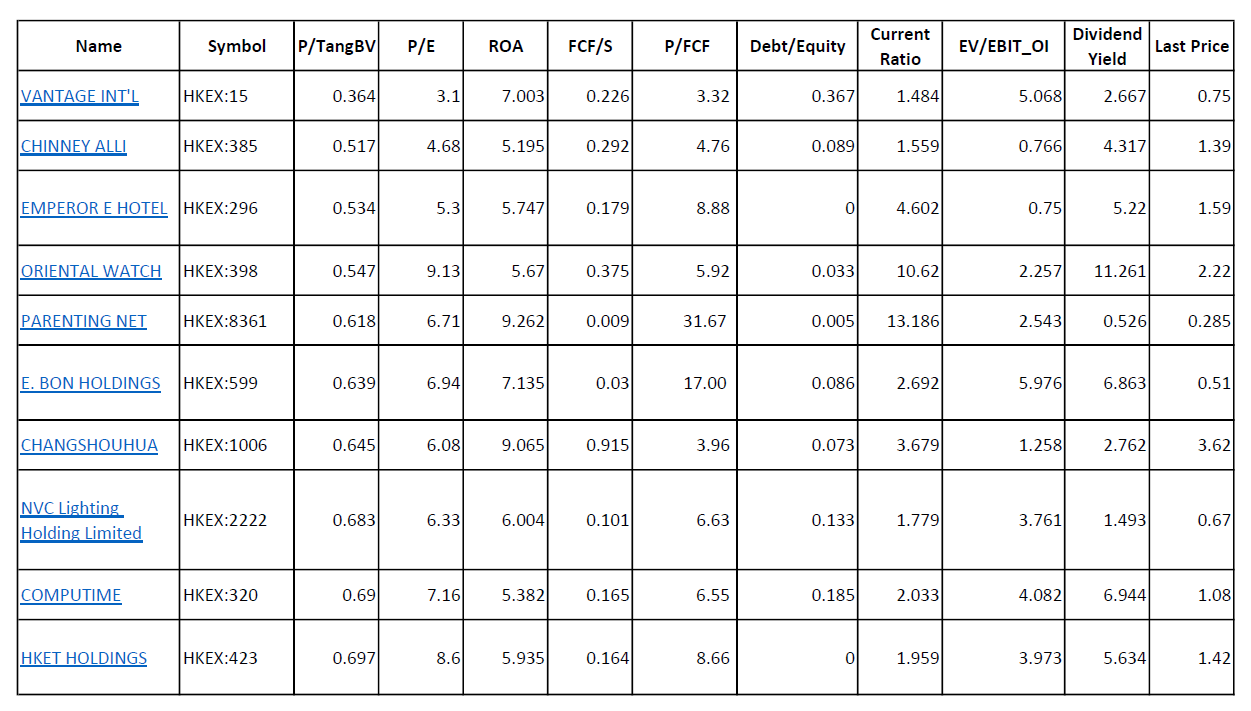
As of now, the Hang Seng Index stands at 28,232.99 points. We will explore the results next year 27-Feb-2019.
These stocks have the following:
a) a book value of less than 70 cents to a dollar
b) less than 50 cents of debt for every 1 dollar of equity
c) less than 8 times of operating income compared to its enterprise value (market cap - cash + debt).
d) current ratio > 1.5
The following stocks were generated by stock.cafe, and are pure HKEX plays. I think dividends should be taken into account. Can these stocks beat the index (Hang Seng Index).
As of now, the Hang Seng Index stands at 28,232.99 points. We will explore the results next year 27-Feb-2019.
Recommend Books Part Two (Essential Readings)
Leading up to the third anniversary of my investing journey, I think an update on recommended study materials is appropriate.
I am still a firm believer of self studying. Investing is not just financial rewarding but intellectually stimulating-- a perpetual treasure hunt.
1. The 5 Rules to Successful Stock Investing
There is not a better book out there (afaik) that explains the financial statements using the simplest of examples: running a hot dog stand. If you know nothing about reading simple accounting stuff, get this book. It will probably take you half a month to finish half of this book.
2. The Intelligent Investor
The writing style and examples used in the text isn't contemporary, but even reading the summaries written by Jason Zweig (latest edition in 2006 covered the melt down in tech meltdown in 2000) will help prevent losses.
As a value investor, we should check the downside and risks instead of the upside-- losing money is often easier than winning.
3. One Up on Wall Street
While this book can serve as a wonderful introduction to investing, it appeals to investors with slight investing experience (such as myself) with little gems like market timing (or why it shouldn't bother you), portfolio management, story checking, etc. Peter Lynch's classification of companies into six different categories is popularly used in the investment circle.
You might be keen on "Beating the Street" by the same author as well.
4. Financial Shenanigans
There are a million and one way for management to commit frauds. One should do one's best to check the numbers... This book will help.
5. You Can be a Stock Market Genius
While it lacks a serious title, this book changes the way I look at unconventional investment opportunities. If you are a fan of the Buffett Partnership, its investments were classified into three categories: Generals, Controls and Workouts. General refers to companies which are undervalued by the market, and after buying enough shares available to control the company, they become part of the Controls group.
The last section, called Workouts, refer to investments which does not move with the general market direction. These are special situations (as termed in book #2) which no doubt lower investment portfolio during a bull market, but greatly provide relief during a bear one. This book deals with Workouts, but even if your portfolio consist mostly of it, it will provide highly satisfying returns.
The same author wrote this book call "The Little Book that still Beats the Market." Another highly entertaining book as well.
6. The Dhando Investor
If you are determined to be a value investor, this book could be priceless. What is the difference between risk and uncertainty?
That is all. You will spend an approximate six months to a year reading all of the above, but re-reading them is not only necessary, but entertaining.
I am still a firm believer of self studying. Investing is not just financial rewarding but intellectually stimulating-- a perpetual treasure hunt.
1. The 5 Rules to Successful Stock Investing
There is not a better book out there (afaik) that explains the financial statements using the simplest of examples: running a hot dog stand. If you know nothing about reading simple accounting stuff, get this book. It will probably take you half a month to finish half of this book.
2. The Intelligent Investor
The writing style and examples used in the text isn't contemporary, but even reading the summaries written by Jason Zweig (latest edition in 2006 covered the melt down in tech meltdown in 2000) will help prevent losses.
As a value investor, we should check the downside and risks instead of the upside-- losing money is often easier than winning.
3. One Up on Wall Street
While this book can serve as a wonderful introduction to investing, it appeals to investors with slight investing experience (such as myself) with little gems like market timing (or why it shouldn't bother you), portfolio management, story checking, etc. Peter Lynch's classification of companies into six different categories is popularly used in the investment circle.
You might be keen on "Beating the Street" by the same author as well.
4. Financial Shenanigans
There are a million and one way for management to commit frauds. One should do one's best to check the numbers... This book will help.
5. You Can be a Stock Market Genius
While it lacks a serious title, this book changes the way I look at unconventional investment opportunities. If you are a fan of the Buffett Partnership, its investments were classified into three categories: Generals, Controls and Workouts. General refers to companies which are undervalued by the market, and after buying enough shares available to control the company, they become part of the Controls group.
The last section, called Workouts, refer to investments which does not move with the general market direction. These are special situations (as termed in book #2) which no doubt lower investment portfolio during a bull market, but greatly provide relief during a bear one. This book deals with Workouts, but even if your portfolio consist mostly of it, it will provide highly satisfying returns.
The same author wrote this book call "The Little Book that still Beats the Market." Another highly entertaining book as well.
6. The Dhando Investor
If you are determined to be a value investor, this book could be priceless. What is the difference between risk and uncertainty?
That is all. You will spend an approximate six months to a year reading all of the above, but re-reading them is not only necessary, but entertaining.
Thursday, August 23, 2018
Complete Divestment of Playmate Holdings; Rethinking my approach
I have divested my shares in Playmates Holdings (HKEX: 635). Over the months since Jan, I am slightly worried about a few points of this company:
a) Lower occupancy of investment property. It is noted that the company seems to have an attraction to Savills, having it being the property manager and the property surveyor. AFAIK, their method of valuation is level 3, which is worrying because the increase in value of its properties looks like a bubble in itself.
b) Reducing earning ability of its main toy business. I am not enamored of the quality of its upcoming toys as well.
c) Slight increase in non-current loans for no reason despite its reasonably high cash position. I note that interest coverage this half is still a safe 20 times or so-- but why incur unnecessary debt?
d) Share buy backs using company's fund is encouraging but I rather the directors buy it using their own pocket and try to improve business.
e) I noted that the investment portfolio has increased by 40-50m or so, but there is no explanation for how they pick stocks, or who is managing their investments. Active investing is not easy-- especially with large money.
Overall gain in investment for Playmates, inclusive of the recent special dividends, is only 10%. This means I sold at break even price.
Moving on, I would like to share some opinions on retail investing.
Walter Schloss is my idol and I still find investing in his way the easiest. His returns might not be the highest, but investing is not about topping the class-- it is about getting decent returns over long period of time. I do think that if you end up in the top 25% of the investing community every year over long period of time (10 years), the results would be lovely.
However, buying a small position over many companies requires a full time job. After reading The Dhandho Investor, I feel the practical method is to buy when you have ascertain a huge opportunity, and bet heavily. I think 8 is enough for diversification.
In addition, the age-old belief in value investing is that you either buy a so-so company at a cheap price, or a great company at a fair price. Over time, I do think that the latter approach is easier. It is definitely easier to spot a company when it is cheap. If I have a sizable (400k-1m) amount of money to work with, leaving 50% of it for cheap companies is plausible. With the amount of money I have, I do need to rethink my approach to compound it efficiently.
a) Lower occupancy of investment property. It is noted that the company seems to have an attraction to Savills, having it being the property manager and the property surveyor. AFAIK, their method of valuation is level 3, which is worrying because the increase in value of its properties looks like a bubble in itself.
b) Reducing earning ability of its main toy business. I am not enamored of the quality of its upcoming toys as well.
c) Slight increase in non-current loans for no reason despite its reasonably high cash position. I note that interest coverage this half is still a safe 20 times or so-- but why incur unnecessary debt?
d) Share buy backs using company's fund is encouraging but I rather the directors buy it using their own pocket and try to improve business.
e) I noted that the investment portfolio has increased by 40-50m or so, but there is no explanation for how they pick stocks, or who is managing their investments. Active investing is not easy-- especially with large money.
Overall gain in investment for Playmates, inclusive of the recent special dividends, is only 10%. This means I sold at break even price.
Moving on, I would like to share some opinions on retail investing.
Walter Schloss is my idol and I still find investing in his way the easiest. His returns might not be the highest, but investing is not about topping the class-- it is about getting decent returns over long period of time. I do think that if you end up in the top 25% of the investing community every year over long period of time (10 years), the results would be lovely.
However, buying a small position over many companies requires a full time job. After reading The Dhandho Investor, I feel the practical method is to buy when you have ascertain a huge opportunity, and bet heavily. I think 8 is enough for diversification.
In addition, the age-old belief in value investing is that you either buy a so-so company at a cheap price, or a great company at a fair price. Over time, I do think that the latter approach is easier. It is definitely easier to spot a company when it is cheap. If I have a sizable (400k-1m) amount of money to work with, leaving 50% of it for cheap companies is plausible. With the amount of money I have, I do need to rethink my approach to compound it efficiently.
Wednesday, August 15, 2018
Portfolio Commentary: August.
The market has been terribly kind to me lately, and I feel embarrassed as I witness other investors' portfolio get smashed pretty bad. I perceive some of them to be better investors really, so I guess Lady Luck has something to do with it.
As of writing, portfolio returned 18.98%, versus a -2.04%. This lead of 21% over the index is unprecedented.

Transactions made since the last update included:
(a) Complete divestment of Wheelock Properties. While it was a low ball offer, it makes little difference if the price offered is 2.4 or 2.2. I was waiting for 2.3 but it meant very little difference to me. Gains, largely due to luck, is about 40%.
(b) Complete divestment of Religare Health Trust. This is a "special situation" component of my portfolio, but I think there is a few headwinds ahead. RHT brought home a 9.7% return.
i) general cheap stocks-- these stocks are typically bread-and-butter of your portfolio, and are expected to bring about most gains. However, they are likely affected by general market direction.
ii) special situation stocks-- these are stocks that moves without regard to general market sentiments. Gains are likely to be lesser, but they provide some kind of stability in a bearish market. Assessing how likely the deal will work out is the key here. The attractiveness of investing in such deals is a rough time line where annualized gains can be worked out.
I have since invested part of the sum from RHT's divestment on another idea. I hope to allocate more capital to this idea as I think this stock is reasonably cheap and the company's cash return is very satisfying. I will talk more about this company once I acquire a decent size amount of shares.
(c) Complete divestment of Perfect Shape, at about 40% as well. The annual report fail to explain why there is a growing amount of trade receivables. Funnily enough, the market is clearly not bothered about it and the stock went up significantly. Had I hold on to my stock, I would have my first ever 100% return from a stock. But holding on to it is not rational; the TR is no longer my problem but someone else.
(d) Increase in position of Innotek. For the CEO to double his positions at 40 cents a share, I thought getting a few stock at 36 cents is not a bad idea, and that was what I did yesterday. My luck seems incredible as I wake up to news today that Innotek has improved its latest quarter earnings dramatically. Stock closes at 42 cents, up 13.51%. Again, I take no credit for luck.
I must mention that this stock at one point bore unrealized profits of well over 50%, but I held on as I thought it is still too cheap. The stock corrected significantly after a poor quarter (typical market reaction that offer opportunities to the patient investor), to under 10% profit. This is stomach-wrenching volatility that a value investor have to endure at times.
There are still more than a couple of laggards in my portfolio-- laggards which will be favorably priced by the market sooner or later, I hope...
As of writing, portfolio returned 18.98%, versus a -2.04%. This lead of 21% over the index is unprecedented.

Transactions made since the last update included:
(a) Complete divestment of Wheelock Properties. While it was a low ball offer, it makes little difference if the price offered is 2.4 or 2.2. I was waiting for 2.3 but it meant very little difference to me. Gains, largely due to luck, is about 40%.
(b) Complete divestment of Religare Health Trust. This is a "special situation" component of my portfolio, but I think there is a few headwinds ahead. RHT brought home a 9.7% return.
***
A typical value investing portfolio looks like some this:i) general cheap stocks-- these stocks are typically bread-and-butter of your portfolio, and are expected to bring about most gains. However, they are likely affected by general market direction.
ii) special situation stocks-- these are stocks that moves without regard to general market sentiments. Gains are likely to be lesser, but they provide some kind of stability in a bearish market. Assessing how likely the deal will work out is the key here. The attractiveness of investing in such deals is a rough time line where annualized gains can be worked out.
***
I have since invested part of the sum from RHT's divestment on another idea. I hope to allocate more capital to this idea as I think this stock is reasonably cheap and the company's cash return is very satisfying. I will talk more about this company once I acquire a decent size amount of shares.
(c) Complete divestment of Perfect Shape, at about 40% as well. The annual report fail to explain why there is a growing amount of trade receivables. Funnily enough, the market is clearly not bothered about it and the stock went up significantly. Had I hold on to my stock, I would have my first ever 100% return from a stock. But holding on to it is not rational; the TR is no longer my problem but someone else.
(d) Increase in position of Innotek. For the CEO to double his positions at 40 cents a share, I thought getting a few stock at 36 cents is not a bad idea, and that was what I did yesterday. My luck seems incredible as I wake up to news today that Innotek has improved its latest quarter earnings dramatically. Stock closes at 42 cents, up 13.51%. Again, I take no credit for luck.
I must mention that this stock at one point bore unrealized profits of well over 50%, but I held on as I thought it is still too cheap. The stock corrected significantly after a poor quarter (typical market reaction that offer opportunities to the patient investor), to under 10% profit. This is stomach-wrenching volatility that a value investor have to endure at times.
There are still more than a couple of laggards in my portfolio-- laggards which will be favorably priced by the market sooner or later, I hope...
Subscribe to:
Posts (Atom)
-
 Portfolio Returns: 99.3% STI: 29.2% Tracker: 25.6% S&P 500: 13.35% I believe returns should be correct this time round since Evan of Sto...
 -
 I know some of you are reading this because Kyith wrote about XB and I was mentioned. I just want to put this up right away: I don't hav...