Pages

Search This Blog

Saturday, May 5, 2018

Super Companies-- First Cut


The following companies are what I see as “super companies.” They managed high returns on assets, on a 5 years or more basis. Their place in this list does not mean that they are priced right—which is the cornerstone of value investing, buying stocks are the right price. The other precaution is that returns mentioned here does not refer to cash returns. This should be used as the first cut.


Singapore
  • Sheng Siong (OV8)
  • SGX (S68)
  • Micro-Mechanics (5DD)
  • Riverstone (AP4)

Hong Kong
  • HKEX:1382 - Pacific Textiles Holdings Limited - Declining business.
  • HKEX:586 - China Conch Venture Holdings Limited - inconsistent FCF
  • HKEX:8138 - Beijing Tong Ren Tang Chinese Medicine Company Limited - nice but too pricy at the moment.
  • HKEX:303 - Vtech Holdings Limited - no growth in earnings
  • HKEX:1126 - Dream International Limited - nice company.
  • HKEX:1234 - China Lilang Limited
  • HKEX:2283 - TK Group (Holdings) Limited
  • HKEX:2020 - ANTA Sports Products Limited
  • HKEX:1093 - CSPC Pharmaceutical Group Limited
  • HKEX:837 - Carpenter Tan Holdings Limited
  • HKEX:3918 - NagaCorp Ltd
  • HKEX:1999 - Man Wah Holdings Limited - statistically good but not cheap
  • HKEX:52 - FAIRWOOD HOLD
  • HKEX:1830 - PERFECT SHAPE - vested.

Early promises (2-3 years of high ROA)

Singapore

  • HG Surgical (1B1)
  • MM2 Asia (1B0)
  • TalkMed (5G3)

Hong Kong

  • HKEX:6858 - Honma Golf Limited
  • HKEX:520 - Xiabuxiabu Catering Management (China) Holdings Co., Ltd.
  • HKEX:1523 - Plover Bay Technologies Limited
  • HKEX:1345 - China Pioneer Pharma Holdings Limited
  • HKEX:1500 - In Construction Holdings Limited
  • HKEX:2138 - Union Medical Healthcare Limited
  • HKEX:1572 - China Art Financial Holdings Limited
  • HKEX:799 – IGG
  • HKEX:6822 - Kings Flair International (Holdings) Limited
  • HKEX:1513 - LIVZON PHARMA


Such companies definitely have attracted the eye balls of investors—whether the business is generating cash, or that it is priced right—is another matter.

Wednesday, April 4, 2018

A Stroke of Bad Luck


Every now and then, the market throws you a curveball that is impossible to hit.
This is a story about Xinghua Port Holdings (XPH). What started out as a promising spin-off opportunity could end up terribly wrong as I am writing this.

Let’s begin with the investment thesis. XPH is a spin-off from Pan-United. The terms are simple—one share of XPH for every existing share of Pan-U. So it is no surprise that post-spin-off, XPH will experience selling pressure, which it did. Shortly after, XPH announced its full year results and it was not too shabby. To summarize, the earnings per share, without the listing fee taken into account, will mean that XPH is trading at some 10 PE. Insiders has been buying from the open-market while it was selling at 1.1-2. A Frost&Sullivan analyst remarked that the business should experience a CAGR of about 10 percent.

The Speculative “Opportunity That I Missed”

The idea of investing in spin-off is that the price is temporarily under pressure due to selling—hey, these shares are free, so it is normal for a disinterested Pan-U shareholder to dispose them for profits.

Right after I shared this idea with a senior investor in the morning, the stock went up to as high as 1.8 dollars. I didn’t get to “see” it live—it was a few hours after the fact. So the opportunity for me to trade this stock is $1.5. That represents a 36% profit in a matter of days.

I did my math and refuse to sell. The reason is simple: This stock is cheap. It should be earning a EPS of 0.174 HKD per share. At a not-so-extravagant PE of 10, this stock should trade at 1.74 HKD.
So I key in a 1.74 sell and went back to work. The trade didn’t materialized after all.

The Sell-down
So the HKEX being much more volatile in nature, sold this stock from 1.5 to 1.2x. I bought more at 1.28. Every time the market moves down with no economic basis behind it, I will act. Hence, XPH became my 2nd biggest position in my little portfolio.

The Real Bad News
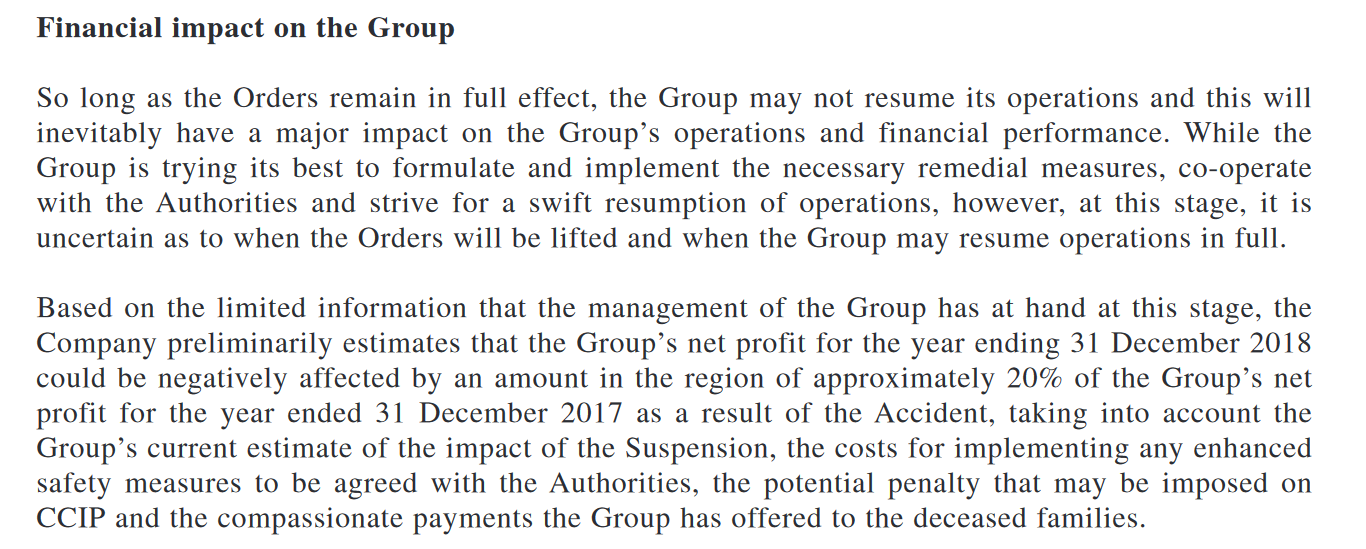
On 2nd April, this happened:


And a couple of days later, the company follow-up with:

Things can go horribly wrong from here, so this stock will suffer an approximate 20% loss in stock price or more. I suspect this will have a serious drag down on my portfolio. I am now expecting to under-perform any indices out there. In fact, XHP dropped -6.5% yesterday. Together with the sell-down on all my other holdings, I am now less than 5% ahead of the market. Just days ago, the lead was about 10%.

I have clearly only 2 options here:
(a) invest more at -20% (or more!)
(b) sell half and ride the storm; this halved the risk, and I am unlikely to get a decent price tomorrow. This could be followed up with (a).

I have no intent to sell everything as I believe this problem is temporarily. I believe in investing when there are problems-- unfortunately I am now vested before problem struck.

It is certainly easy to invest during a downtrend when there are no news, but this is different.

Thursday, March 22, 2018

Portfolio Updates, 2018 First Quarter

The market continues to be kind to my little portfolio. As of 22nd March 2018, the scoreboard is as such, year-to-date:
STI ES3: +2.67% (from Stocks.Cafe)
(STI ES3, from my own calculation, returns 0.053 in dividends, and stands at 3.49, which means it is 3.543. It started at 3.48 this year. Is the actual returns 1.81%?)

Hang Seng Index:  +1.82% 
(this might be wrong, I just did my own maths; no idea about the dividends either.)

My own little fund: about 11.12%, inclusive of dividends. 

The reason for including the Hang Seng index is because a third of my portfolios are now parked in HKEX securities. I found a couple of good opportunities there as well as took the advice for one of them. 

I will write about some of them soon.

None of my holdings are bought based on promising macro news brought about by the media or the brokerages. You will find no Hi-P, AEM, Best World, Delong, etc. Most are picked for their cheapness rather than their shine. I have some confidence that I should be able to do well in the future, since picking stock this way is a) not an activity enjoyed by the majority and b) produce relatively pleasing returns as expounded by value investing principles.

Unlike a typical classroom environment, where students compete to be #1, I am fine with finishing between #10-15 in a class of 40. Returns from investments will not differ too much from general market conditions (unless I really turn out to be smarter than I thought...).

Tuesday, March 6, 2018

A simple look at HRNetGroup

HRNetGroup is a human resource provider that has announced results recently.
What surprised me is that amount of cash on hand at the moment, a good 289m.
That translate to net cash position of 289m - (all liabilities) 54.698m= $0.2317 net cash per share.

The market is offering us about $0.78 per share. If we take away that figure by net cash per share, that translate to about $0.548252 per share.

Net income goes to 46.342 or $0.04582 per share.

That translate to about a PE of 11.9.

Provided this company continues to do well, I think there is a good chance of undervaluation.

Saturday, February 10, 2018

Commentary (2-Jan to 8-Feb)

Markets worldwide had investors cringing in just a space of a week. At the start of this year, STI went from 3430 to as high as 3609 points on Jan 24. Bulls were cheering, optimistic that markets will go higher due to the strong economic indicators. Personally, I do not believe the economy and the stock market is correlated. Neither does it has to be for my approach to investing to work.

Towards the end of January, I decided to move a huge portion of my cash holdings to Singapore Savings Bonds. It wasn't because the returns were attractive. Bonds can't protect you from inflation. There wasn't any great ideas in the stock market. Screened results off 52-weeks low and low price-to-cashflow stocks were relatively unchanged week to week. I decided to sell off certain stocks that I wasn't strongly confident of, such as Duty Free International, Figtree and Comfortdelgro. For Comfortdelgro, the run up in price was an excellent opportunity to correct my valuation mistake. I also took profit on Chuan Hup which returned me well above 40%. Chuan Hup is largely cheap based on a sum-of-the-parts approach. However, some of the parts were not cheap themselves. I would say it was on the high end of fair value.

My timing to sell these stocks were fortuitous as the markets turned.

On the 2nd of Feb, all hell broke loose over at the states, and investors in Asia had a weekend of worry before collectively selling off on Monday. STI open at 3414, went down as low as 3353 and closed at 3406. I would say the bears gained complete control the next day, wrestling the index down to 3383 despite it going above the previous close at 3460 at one point. Ironically, speculators in the inverse ETFs were burnt big time when the American market recovered a fair bit. Lesson learnt: shorting stocks is not only a game of valuation but also of timing. It is too difficult and best avoided.

Through it all, my little portfolio of small stocks was not spared. Index returns were as high as 6.09% this year, but now it is at -0.27. My portfolio was tamed from 10.16% to 3.91%. The decline is largely inline with the market.

Portfolio went down as much as 5% during the first day of the correction. It was quite frightening. I would be lying if I write that I did not think of selling certain stocks. But I refused to give in to the ridiculous spread. Some of my holdings were neither too expensive to consider selling, and neither is the price too cheap to average down. I decided to hold. I also took the opportunity to buy stocks in the Hong Kong market. The prices weren't attractive so I did not put in too much capital. But I have faith in them, and will buy more if the prices decline.

This blog is not meant to be a self-serving one... so I have some opinions to share on the days ahead.

At times like this, one has to be honest with yourself. The market is no mere Goliath so it takes courage to go against it. If you do have any positions bought on merely hope, it is time to take the conservative side and liquidate. You have to be quite certain of your valuation.

Hold on to stocks that are still on the cheap side. Do not be too depressed if your profitable positions were sold down-- my mates and I were not duly worried as we are quite certain that this isn't a failure of judgement. Likewise, I am not in a hurry to average down on stocks that are down a handful of percentages. I am not in this game to reap quick returns off hopes that the market will rebound quickly. A 10-15% decline is a good chance to average down, but not 5%.

All in all, God bless those souls who defer their judgement to the market. Stick to the way you invest. Do not switch your strategy just because your returns are inferior to others. Markets are seasonal-- certain styles of investing are more effective in some years. Just concentrate on not making too many mistakes and you will do decently.

Tuesday, January 23, 2018

Short Analysis: Playmates Holdings (00635, HKEX)

Playmates Holdings, the parent company of a listed company called Playmates Toys, is one of the companies that registered within the 52 weeks low of my stock screener in Stocks.cafe.

Although it is in my 52week low list, it isn't technically at 52 weeks low-- the price is brought down due to a 1-to-10 share split. Current price is at a high for this stock.

I didn't spend too much time on this company, probably an hour's work. Playmates Toys key products lies in selling Teenage Mutant Ninja Turtles, Voltron and Ben 10. The first got plenty of boost from movies last year, but this year sales is terrible-- a drop of 36%. There is no illusion that this is a declining business. Playmate Holdings, besides its toy business, consist of investments and F&B. F&B contributions are insignificant. The toys business is Playmate Holding's bread and butter business.

My investment philosophy is simple: let the market bring the deals to you, make an evaluation and if the market is underpricing the company significantly, buy it.

From looking at its cashflow statement last year, it is clear that the company bought back a lot of shares. Adjusted for splits, it had 2.2billion shares on 1st Jan 2016, but now it has 2.08B. That is 120 million shares bought back by this company, representing a staggering 5.4% reduction in shares.

This is facilitated by the company's strong free cash flow despite a declining business.
It is still able to pay out dividends in recent years, a yield of about 2.8-3%.

The cash makes a difference in a couple of ways.
1)
The cash position is significant; based on its interim annual report, 1.48B worth of cash. It has a total liabilities of about 930m, so we talking about 547m in net cash (minus all liabilities!).

Take that 547m of cash, deduct by 2.08b of total shares, you get 0.263 HKD per share.
The current share price is 1.04 HKD. This means you are paying about 0.77 HKD per share.
The earnings for this interim 2017 report (means first half) is 0.328 HKD per share. Year-on-year, the income statements has been showing a decline, from 0.5 in 2013 to -0.05 last year. However, the loss was due to a 300+m downward revaluation of its properties. Without it, they should be earning 0.15 HKD per share. So this is a PE of about 7-8 on today's price.

I am assuming that business is so bad this year that we are getting maybe 0.6 HKD for the whole of this year (remember, it is 0.328 for first half). So based on the revised price of 0.77 HKD (due to its cash position), we are looking at a PE of about 13. This is fair.

It generated about 400m of free cash flow last year. This cashflow should reduce drastically since the breadwinner is from the toys (and it is bad business). Let say it will reduce to 300m this year (we are at 150m FCF this first half), and since market is giving a price tag of (2080m x 1.04HKD) = 2163m HKD, you getting a cash yield of 13.8%. This is very, very high cash yield. But take note that this is a declining business. Even at 200m, it is about 10%.

2)
It has about 500m of bank loans to pay this year. It can do it with its cash position, or refinance. I have no idea what they going to do, but it isn't going to be a problem. The interest is about 2.8%, but it is variable (float).

Price-to-Book is low, but it is just 1 aspect of valuation
I won't go through how I discount various portions of the assets, but a remarkable amount is reduced from receivables and inventories (mark down 50%). This gives me net asset of 5.373B, or about 2.58 HKD per share. The market is offering us this company at 2.163B or 1.04 HKD a share.

Off-balance sheet, it has licensing commitments to pay for about 150m in the next 5 years. I think it is manageable.

Summary
This is another example of a cheap company with a declining business, with a small amount of dividend. Again, business needs to turnover, but I think buying a small amount of shares for this company is quite safe.

Update as of 21-March-2018
Playmate Holdings reported earnings per share of 13.54 cents. As of now, the market price is HKD $1.07, which means our PE is 7.9. If we were to discount net cash (of all liabilities) worth HKD 0.25, we talking about (1.07-0.25)/0.1354 = PE of 6.06.

Free cashflow comes to 290.423-34= 256m. Market Cap is 2.14B. Cash net of all liabilities is 1423.625m - 766.739 - 134.273 = 522.613m.

This means we are actually paying 1617.387m for the business. Since we are getting 256m cash from this business, this means the price to cash flow is 6.32 times. EV/EBITDA is 1388.58/372.857 is about 3.57. This company is ridiculously cheap and I will be looking to accumulate more on price weakness.

Saturday, January 20, 2018

Essential Books

After 2 years of investing, these are my favourite books that I feel are essential to every investor-wannabe out there.

Do follow the order as listed, as it will prevent you from making serious mistakes in your investments.

1. The 5 Rules to Successful Stock Investing
I have not seen a book that explains financial statements as well as this. Even if you lack basic accounting knowledge, this book will turn you into a competent interpreter of financial statements. How the balance sheet, income and cashflow statement relate to each other, using its example of a hot dog stall, is a beauty.

Bonus: If you enjoy the work of this author, he as another book call "The Little Book the Builds Wealth." While not essential in my eyes, it is informative and discusses what constitutes as a moat/durable business advantage.

2. The Intelligent Investor
The writing style and examples used in the text might not suit contemporary readers, but even reading the summaries written by Jason Zweig (latest edition in 2006 covered the melt down in tech meltdown in 2000) will help prevent losses.

As a value investor, we should check the downside and risks instead of the upside-- losing money is often easier than winning.

3. One Up on Wall Street
While this book can serve as a wonderful introduction to investing, it appeals to investors with slight investing experience (such as myself) with little gems like market timing (or why it shouldn't bother you), portfolio management, story checking, etc. Peter Lynch's classification of companies into six different categories is popularly used in the investment circle.

4. Financial Shenanigans
Let's say you are interested in investing in a growth stock, and the numbers look solid. But you are wary of getting suckered into frauds like Enron, Worldcom or Sunbeam... this is your book. Frequently updated to cover the latest trends (and lies) of the financial industry, this book is now in its third edition.

The market is a tough place. You need this book to protect yourself.

5. You Can be a Stock Market Genius
While it lacks a serious title, this book changes the way I look at unconventional investment opportunities. If you are a fan of the Buffett Partnership, its investments were classified into three categories: Generals, Controls and Workouts. General refers to companies which are undervalued by the market, and after buying enough shares available to control the company, they become part of the Controls group.

The last section, called Workouts, refer to investments which does not move with market sentiments. These are special situations (as termed in book #2) which no doubt lower investment portfolio during a bull market, but greatly provide relief during a bear one. This book deals with Workouts, but even if your portfolio consist mostly of it, it will provide highly satisfying returns.

The same author wrote this book call "The Little Book that still Beats the Market." Another highly entertaining book as well.

6. The Dhando Investor
If you are determined to be a value investor, this book could be priceless. What is low risk, high returns? What is the difference between risk and uncertainty?

That is all. You will spend an approximate six months to a year reading all of the above, but re-reading them is not only necessary, but entertaining.

May 2026 Portfolio Update

Both S&P and STI is about 10% at the moment, while HSI is looking at about negative 1%. This year is not a great year... I am on 4% at t...